One of the quickest ways to make a garden feel “expensive” is also one of the simplest: make sure something is always blooming. Succession planting is the gentle strategy behind that magic. Instead of relying on one big flush of flowers (and then a long slump), you plan for overlapping waves of color by mixing plants with different bloom windows and sowing a few things more than once.
If you have ever had a gorgeous May garden that turned into a green, slightly judgmental hedge by July, this is for you. No perfection required. Just a plan, a few repeatable habits, and the willingness to replant a gap or two without taking it personally.
Quick note: timing depends on your frost dates and how fast your soil warms. Use the guidelines here as a starting point, then adjust to your yard’s reality.

What it means
Succession planting for flowers is the practice of staggering bloom times so your beds and borders have consistent color. You can do it in three main ways:
- Bloom-time layering: Choose early-, mid-, and late-season plants so one group takes over as another fades.
- Staggered sowing: Plant the same annual flower every 2 to 4 weeks for repeated bloom waves.
- Swap and fill: Replace spent plants or tuck fast bloomers into openings as the season changes.
Think of your garden like a relay race. You are handing the baton from bulbs to perennials to annuals, and back again.
Make a bloom calendar
You do not need a spreadsheet, unless spreadsheets bring you joy. A bloom calendar can be a simple list of seasons with a few anchor plants in each.
Step 1: Mark your big windows
- Spring: snowmelt to late spring
- Early summer: the bridge season
- Summer: heat season
- Fall: cooler nights to frost
Step 2: Choose 2 to 3 anchors per window
Anchors are plants you can count on for a strong show. Then you add “fillers” and “gap-bridgers” around them.
Example anchor set:
- Spring: tulips, daffodils, hellebores
- Early summer: bearded iris, catmint (Nepeta), hardy geranium
- Summer: coneflowers, garden phlox, zinnias
- Fall: asters, sedum (stonecrop), chrysanthemums
The goal is overlap. If everything peaks in the same two weeks, you get fireworks and then silence.
A real-life example
Say your last frost is mid-May and your first frost is mid-October. Your succession rhythm can look like this:
- Late March to April: direct sow cool-season flowers as soon as soil can be worked, or plant hardened-off transplants.
- Mid-May to early June: plant heat lovers once nights are reliably warm and soil has warmed (often around 60°F or 15 to 16°C).
- Early June: second sowing of zinnias or cosmos.
- Late June to early July: third sowing if you want flowers into fall.
- Late August: optional fall sowing of fast cool-season annuals only if you still have about 6 to 8 weeks before frost.
It sounds like a lot until you remember each sowing can be a small patch. A pinch of seed here, a small row there, and suddenly August is not a beige situation.
Design rules that work
Rule 1: Repeat, do not sprinkle
For a bed to read as intentional across the season, repeat your key plants in clumps of 3, 5, or 7 (depending on bed size). Small groups bloom better visually and hide each other’s awkward phases.
Rule 2: Hide the fade
Every flower has a not-so-cute stage. The trick is to cover declining foliage with something that comes up later.
- Let daffodil foliage die back behind later-emerging perennials like hosta or daylily.
- Pair peonies (stunning bloom, then just leaves) with summer performers like salvia or catmint.
- Tuck cosmos or zinnias near spring bulbs to fill in after bulbs finish.
Rule 3: Mix shapes, not just colors
Succession planting looks more natural when you mix forms: spires (salvia), daisies (echinacea), umbels (yarrow), and airy fillers (verbena bonariensis). Your garden stays interesting even when the palette shifts.
Rule 4: Include long-haulers
These are plants that bloom for weeks, not days. They bridge the gap between seasonal peaks.
- Perennials: catmint (Nepeta), coreopsis, hardy geranium, coneflower, yarrow
- Annuals: zinnias, cosmos, calendula, sweet alyssum, nicotiana
Rule 5: Use a midseason haircut
Some perennials will give you a tidy second act if you shear them after the first big bloom. Catmint is famous for this. A quick trim can turn a floppy June patch into a fresh mound that keeps going.

Mix perennials and annuals
Perennials are your structure. Annuals are your seasonal paint. If you let perennials do the heavy lifting, annuals become a fun, flexible layer instead of an exhausting obligation.
A simple ratio
- 70 percent perennials and shrubs for reliable return blooms and shape
- 30 percent annuals for long bloom and gap-filling
Where annuals help most
- Front edges: where you notice gaps first
- Between young perennials: while the bed matures
- After early perennials fade: slot in warm-season color
If you are a beginner, choose annuals that are forgiving and quick: zinnias, cosmos, marigolds, calendula, sunflowers, and nasturtiums.
Staggered sowing
This is the part that makes people think succession planting is complicated. It is not. You are simply planting the same thing more than once.
Warm-season annuals
For zinnias, cosmos, sunflowers, basil, and other heat lovers:
- Plant after last frost, once nights are reliably warm and soil has warmed (cool soil can stall or weaken true heat lovers).
- Repeat every 2 to 4 weeks for 2 to 3 rounds.
- Stop 8 to 10 weeks before first frost in cooler climates, so the last sowing has time to bloom.
A sunflower note, because sunflowers are lovable and chaotic: many cutting-garden varieties are single-stem, meaning they make one flower per plant. If you want repeat blooms from the same plant, look for branching types.
Cool-season annuals
For calendula, sweet peas, snapdragons (often best as transplants), and bachelor’s buttons in many regions:
- Start early: sow as soon as soil can be worked, or plant hardened-off transplants.
- Do a second sowing: 3 to 4 weeks later.
- Optional late-summer sowing: for fall color if you still have about 6 to 8 weeks before frost. In short-season climates, it may not have time to size up.
My favorite mindset shift: you are not “behind” if you are planting in June. June planting is how you get August flowers.

Plant combinations
Below are dependable handoff pairings. Adjust varieties for your climate, but keep the idea: early bloomers hand off to midseason, then late-season finishers.
Sunny border
- Spring: daffodils + tulips (mid-season types) + creeping phlox
- Early summer: catmint + bearded iris
- Mid to late summer: coneflower + rudbeckia + zinnias tucked in front
- Fall: asters + sedum (stonecrop) + ornamental grasses
Cutting bed
- Cool season start: snapdragons + calendula
- Summer workhorses: zinnias (succession sow) + cosmos (succession sow) + basil and dill for fillers
- Late season: celosia + hardy asters
Part shade
- Spring: hellebores + bleeding heart
- Early summer: astilbe + hardy geranium
- Late summer: Japanese anemone (in many regions) + begonias or impatiens as annual color
- Fall: toad lily (Tricyrtis) + shade-tolerant mums in pots you can tuck into gaps
Containers absolutely count as succession planting. A few movable pots can rescue a bed that has a midseason lull.
Use bulbs for spring
Bulbs are the easiest way to guarantee early color because they show up before many perennials even stretch.
Bulb succession tips
- Mix early, mid, and late varieties of tulips and daffodils.
- Layer different bulb types with different bloom windows, like crocus, early tulips, late tulips, and alliums. This is the real secret behind “lasagna planting.”
- Plan the cover-up: plant bulbs among perennials that leaf out later, so fading bulb foliage is hidden.
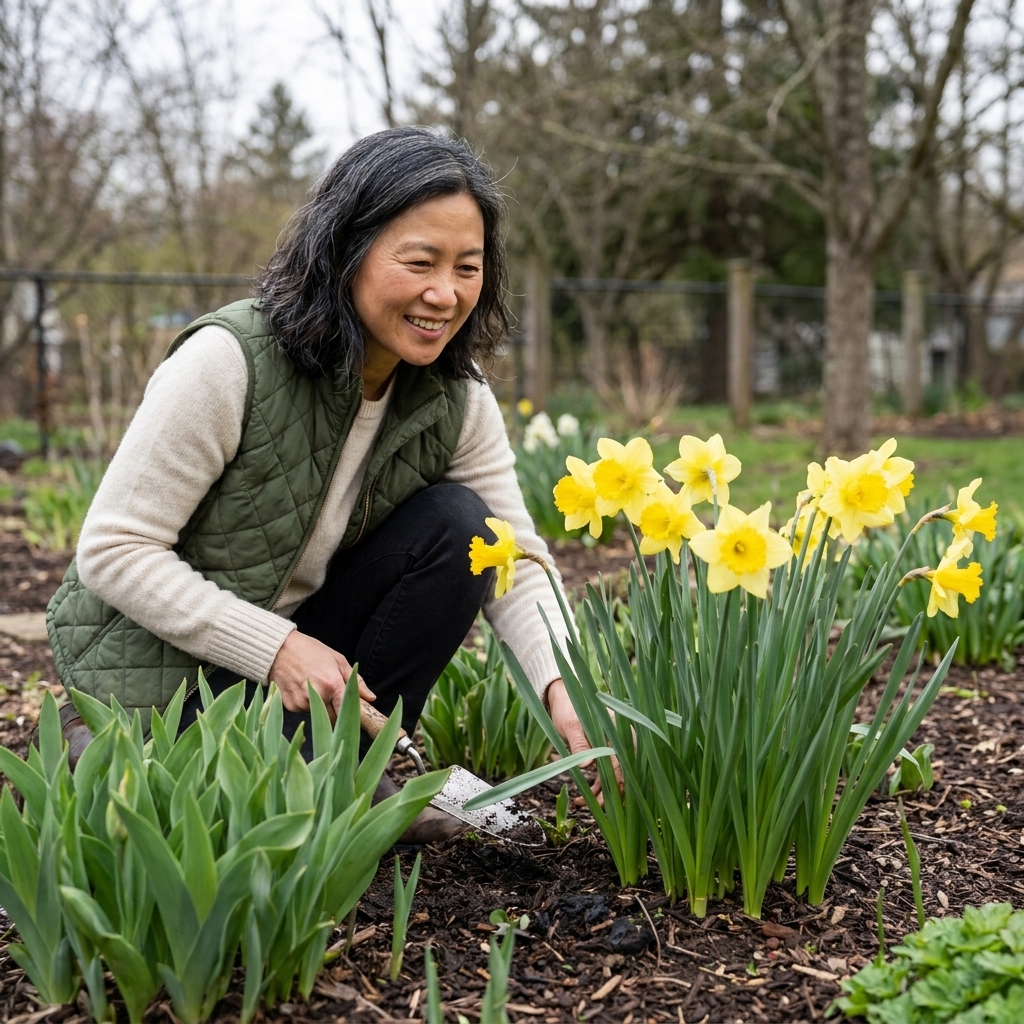
If you only do one thing this year: plant a blend of early, mid, and late daffodils. They are often deer-resistant and usually more critter-resistant than tulips, though determined squirrels and voles can still be a nuisance.
Extend bloom with care
Succession planting is not only about what you plant. It is also about how you manage what is already blooming.
- Deadheading (removing spent flowers) keeps many plants blooming longer, especially zinnias, calendula, coreopsis, and roses.
- Cutting flowers for bouquets often acts like deadheading and encourages more blooms.
- Pinching (snipping the growing tip) makes some annuals branch and bloom more, like snapdragons and basil. For mums, pinching in early summer can create bushier plants with more fall blooms.
- Shearing (a light haircut) can bring on a second flush for some perennials, especially catmint.
If deadheading feels endless, focus on just a few high-impact plants. Even 10 minutes after dinner, a couple nights a week, changes the whole look of a bed.
Keep sowings strong
Succession sowing works best when you treat each new round like a fresh mini-garden, not an afterthought.
- Water for germination: keep the top inch of soil evenly moist until seedlings are up, especially in summer heat.
- Do not crowd: thin seedlings or plant with proper spacing so plants do not stall.
- Feed lightly if needed: a thin layer of compost between rounds (or a gentle organic fertilizer) helps when you are asking the same bed to perform all season.
- Mulch matters: it buys you time between waterings and keeps new seedlings from getting fried.
Season checklist
Spring
- Enjoy bulbs and early perennials.
- Direct sow cool-season annuals where appropriate.
- Take note of gaps as things emerge.
Early summer
- Plant warm-season annuals after frost, once soil is warm.
- Add a second sowing of zinnias or cosmos.
- Stake tall bloomers early so you are not wrestling them later.
Mid to late summer
- Replace tired annuals in high-visibility spots.
- Keep deadheading and watering consistent.
- Start or buy a few fall bloomers for gaps (asters, mums, ornamental peppers in containers).
Fall
- Let some seed heads stand for birds if you like that natural look.
- Plant spring bulbs once nights cool.
- Make notes: when did your bed look its best, and when did it slump?
Common mistakes
Everything blooms at once
Fix: Add late bloomers like asters, sedum, and ornamental grasses. Also plant at least one long-bloom perennial (catmint is a classic).
A green gap after spring
Fix: Tuck in summer annuals near spring stars, or add early summer perennials like salvia, coreopsis, and hardy geranium.
Annuals fizzle by August
Fix: Succession sow earlier, and keep one packet back for a midseason sowing. Also, cut zinnias often and feed lightly if soil is lean.
Fall color never happens
Fix: Plant something that peaks late on purpose. Asters plus sedum is the easiest combo I know. If you are short on time, buy a few mums and slide them into bare spots like floral punctuation.
FAQ
How do I succession plant in a small bed?
Use layers instead of lots of different beds. Bulbs underneath, perennials as your middle, and a narrow ribbon of annuals at the front. Even a 3-by-6-foot bed can cycle beautifully if bloom times overlap.
Do I need to start seeds indoors?
No. Direct sowing works great for many annuals like zinnias, cosmos, calendula, and sunflowers. If you enjoy indoor seed starting, it can give you a head start, but it is not required.
What is the easiest flower to succession sow?
Zinnias. They germinate quickly in warm soil, bloom fast, and the more you cut them, the more they produce. Cosmos is a close second if you like a softer, airy look.
How do I know what blooms when in my yard?
Start a simple note on your phone: “first bloom” and “last good bloom” for a handful of plants. After one season, you will have your own personal bloom calendar, tailored to your microclimate and sunlight.
A gentle final thought
Succession planting is less about controlling nature and more about listening to it. You notice when spring gets tired. You watch which perennials carry the show. You learn that an empty patch in July is not failure, it is an invitation.
And if you replant something and it flops? Congratulations, you are officially a gardener. There is a compost bin full of our past mistakes waiting to turn into next year’s best soil.